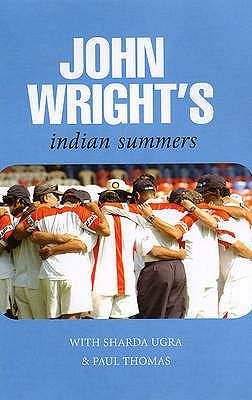
After a cliche fest consisting of boring biographies on Sachin, Rahul, Ganguly and Sehwag, which were no more than a trivial narration of known events and newspaper articles pieced together, comes a very interesting book on the plumbings and inner-workings of Indian cricket. John Wright is an excellent writer and pens together a wonderful recollection of his stay with the Indian team. He is endowed with an excellent sense of humor and uses it very effectively throughout the book. In a short time he takes you through the essence of his heart, mind and ambition. You are left in no doubt about the sincerity of his purpose and equanimity of his retrospection. Looking back, the Indian news channels reconfirmed their stupidity in their review of the book. They conveniently picked the least important, least interesting part of the book — namely Wright’s assessment of Ganguly’s captaincy and projected just that. This book is worth lot more than a silly gossip. John Wright seems to have this wonderful subtlety of leaving many things unsaid. The most interesting aspect about this book was the way he’d abruptly end a narrative or a sentence. It is really not that subtle but provides the ‘what he left unsaid’ feeling in the mind of the reader. Unless you work for a network news channel you would be intelligent enough to understand what he tries hard not to say. There are some really interesting issues that he points out, which I feel have been neglected by main stream reviewers.
Zero Professionalism: We’ve just heard of the term professionalism being used in the media before, but we don’t really know what it translates to in reality. Wright describes that part. It starts with Wright’s description of the cricket kits/practice equipment that he inherited –”3 baseball mitts, 30 cones and three old and crooked blue plastic stumps”. This is the support equipment for an international team. “No drink bottles, no sports drinks, no electrotheraphy unit, no heart rate monitors” — Wright laments. He had to personally request for players clothing and even mentions an instance where due to non-availability, players had to wear morning’s sessions clothes in the afternoon. Even more appalling is his description of practice sessions, when he took over. Professional players taping their fingers for fielding practice is shocking. Wright’s description of net practice, where players who weren’t bowling or batting, lounged about in plastic chairs and were served tea and biscuits, is really funny. But he deals with it — “The cane chairs went the next day. Tea soon followed. The players weren’t bothered. The resistance came from people who lavished this care and attention on their beloved team. It took a while for word to get around that the new foreign coach didn’t believe in tea and biscuits at practice. He didn’t believe in taping fingers either. If you do enough catching practice hands and fingers eventually harden up.”
Team Managers: Even more funny is his review of team managers. This comes under professionalism but this topic is ridiculous enough to merit a separate paragraph. The segment where a trucking business guy becomes the team manager was hilarious. Wright and Leipus had to explain the process of ticket booking, travel agents to him. Sometimes Wright had no Team Manager and he says “I was also the team manager by default, because the BCCI hadn’t appointed one for that series. I relied heavily on Babu Meman for information such as flight times”. One manager was so bored of all the cricket talk that happened in team meetings that he got up in the middle of a meeting and started distributing complimentary tickets. Another one, Colonel Sharma, insisted that he was a Yoga expert and literally jumped in and hijacked a morning-of-the-match practice session by forcing players to do yoga. There have also been managers who “handed out meal allowance money in the dark so that it was hard to count”, “who nicked players official T-Shirts” and “another who managed to lose the entire party’s meal allowance money for last two days”. It is evident that the perks of being a manager involves looting allowance money and depriving players of their comforts. Wright says at one point “the iron law of liaison men was that the smarter they dressed, the more useless they were.” All-in-all it seems like Wright is describing a Kuppusami Colony cricket team set-up and not a team that has a backing of a large institution. Apparently no money flows back into the team. The BCCI even asks the team’s computer analyst to book an economy class room and take care of his charges himself. In one instance Wright terms BCCI’s curmudgeon like treatment of Ramki “demeaning”. He aptly sums up by saying “BCCI’s office in Mumbai, perhaps the greatest feat of camouflage since the wolf put on sheep’s clothing”.
Zero Privacy: This is somewhere between hilarious and sad. Wright says “I would embark on what would be a never-ending, and ultimately unsuccessful campaign to protect the team space.” “In blink of an eye our changing room or viewing area would take an appearance of a cafe renowned as a celebrity hang-out and a place to be seen, a magnet for wannabes.” “I’d arrive at the ground to find that our viewing area had been invaded by well-connected spectators, usually related to high ranking government or cricket officials”. This is my opinion should include most of the dorks who proudly display the dressing room photographs they took with cricketers. But the extent to which this has been a problem is shocking — “ There were times when the team was forced out of their viewing area to make room for the state’s chief minister and his entourage; even the padded up batsman Rahul Dravid had to shift.” John Wright describes two particular anecdotes where he lost his temper and demanded that the person/celebrity in the dressing room leave immediately. One person was Vijay Malya (“a guy with the biggest diamond ear-stud I’d ever seen wandered into the viewing area…I went nuts demanding to know who the hell he was and, more to the point, who the hell he thought he was”). The second person whom John Wright fought with was Niranjan Shah.
Relationship with Selectors and Players: While John Wrights assessment of the well-known selector’s regional bias has been played up by the media, his subtle assessment of his relationship with players has been neglected. Yes! he does talk about the bleeding obvious fact that in 2005 Ganguly had to go — at least from captaincy. But he says more. In the world cup 2003, he un-subtly blames Ganguly, Dravid and Sachin for violating their tour strategy (Bat first in day/night and bowl first in day games) and electing to bowl first in the final. It is one of my pet peeves. To me, we lost the moment Ganguly elected to bowl. Even if we replayed the same game over and over again as a best of 11 finals, we would not have won a WC final, against that Australian team, chasing. He says “Needless to say, if I had my time over again, I’d argue in favor of batting first till I was blue in the face.” In my opinion Sachin should never be forgiven for failing during two important occasions (a) The 3rd test against Aus in Melbourne and (b) The 3rd test against RSA in 2007. John Wright mentions the first one as a failure. He also says that Sachin’s tactics during his 241 in Sydney was a result of a talk they had and recollects the letter Anjali Tendulkar sent to thank Wright for the timely advise. The person who seems to top Wright’s assessment is of course Dravid, who in Wright’s eyes seems to be a ruthless, steely-eyed, cold competitor who is not bothered by trivial emotions and can ‘step back and put things in perspective’. Wright’s assessment of Ganguly is not positive all the time — though he does have some positive things to say about Ganguly. Apart from commenting on Ganguly’s lack of punctuality, and tactical acumen, Wright on a few occasions narrates his frustration when Ganguly says one thing in the dressing room and does the complete opposite on the field. At one point during his narration on Bruce Reid’s tactical contribution during the 2003/04 Australian tour “after one such presentation, he sat there open mouthed as Gangulyproceeded to do the exact opposite of what had been recommended”. His breakdown in relationship with Laxman and Yuvraj is sad. His assessment that Laxman can only find a place in the ODI team if he bats in the top 3 — is a correct one. The selectors decision to drop Laxman for the same reason is a reasonable call. But its hardly Wright’s fault. The amount of effort he puts to repair damaged relationships with Laxman and Yuvraj is heart-warming. There are some heart-warming anecdotes too — Wright’s father walks in when Ganguly and Wright are embroiled in an argument, Ganguly displays what Wright calls “impeccable manners” by switching modes and showing the Indian brand of respect.
Indian cricket was very interesting during John Wright’s tenure. More interesting than it had ever been in the past (or will be in the future). It was a joy to watch a good team. I enjoyed watching Sachin Tendulkar bat during the 90s. I didn’t know I was seeing him at his peak and he would never be the same again. I truly enjoyed how one man stood a cut above the rest of the team. However, that was clearly an attraction towards the skill and artistry displayed by one man. I had scant regard or respect for the 10 idiots who surrounded him. And if Sachin got a 100, I mostly did not care if India won or not. Sometimes, such choices are a result of there being ‘no other choice’. In the first half of this decade, Saurav Ganguly and John Wright put together a team that can be reasonably assessed as the best Indian team ever. For a brief moment in history, we had a team that could do anything. Even show signs of winning a series in Australia. That moment has gone and may never come back again. That is why I was so curious about this book. What made the team tick. Who was responsible? I truly wanted to find out.
Was he genuine? John Wright would probably go down as the best Indian coach ever. The current circus surrounding coach selection reinforces this belief further. There was a good reason for Wright’s success. He saw Indian cricket from a perspective that the people surrounding him took for granted. He saw the Indian cricket fan. Paid attention to the fan. Acknowledged their presence and expectations. A little more than the fan deserved, in my opinion. To me the unique aspect about this book (where a chapter is dedicated to this) and Wright’s tenure was his constant focus on (a) repeating that he was honored to coach India, which had such a passionate fan base (b) doing ‘whats best for the team’. Immediately after appointment, when Wright said that he was truly honored to coach India, no one but Ian Chappell asked him the blunt question — ‘Why?’. That’s because Ian and the rest of the world aren’t the same. The rest of the world, with a reasonable bit of cynicism, thought Wright was either doing ‘lip service’ or was behaving like a foreign tourist. I never wanted to know why a New Zealander, would be ‘honored’ to coach India. But the book made me curious. Wright spends one big chapter on it just say ‘because that’s the kind of person I am’. Also one thing clearly comes out. Everybody involved with Indian cricket had/have their own agenda, which did not always translate to ‘whats best for the team’ — even if this book is Wright’s own perspective, there is enough evidence in it to convince the reader that Wright always kept asking this question to himself and others. A question that was uncomfortable to the selectors, Dalmia, sometimes even Saurav, ex-players, and most certainly Sunil Gavaskar.
Was he Tough? Wright says Javagal Srinath is the heart beat of the team. Clearly holds Srinath in high regard. Mentions how Srinath had been ill-treated by Kapil Dev and how the set-up had robbed Srinath of two good years and valuable coaching. Srinath was the first to get ‘fired’ by Wright in his time as coach — “Srinath was what they called a senior, most senior in fact, and it was his misfortune that I decided to start at the top, with someone I knew who could take it”. Wright recollects several instances where he tells — Harbajan to stay out of the dressing room, a senior player that he should be dropped to which the reply he gets is “tell it to the selectors”. His last chapter which is more of a philosophical discussion on several issues puts all this ‘toughness’ issue into perspective “it annoyed me when pundits questioned whether Dravid was aggressive or tough enough to lead, as if perfect manners off the field reflected the qualities he brought to the contest. Toughness is on the inside; its what you are made of, not what you display; Anyone can walk with a swagger or turn their collar up”
The ex-players This is an interesting aspect of the book. Most ex-players were on the Indian-flag bandwagon, claiming that an Indian coach could do what a foreign coach can. At that time, I strongly believed this was untrue. After reading the book, I don’t feel the need to change my mind. Ravi Shastri is the only ex-player who comes across as professional and sincere in Wright’s book. And Wright writes a book, which has nothing bad about Dalmia. Every player had his own agenda, which annoyed not just the coach but the team as well. Sunil Gavaskar comes out as the most conniving, scheming selfish person in the circuit. John Wright’s take on his ‘Batting Consultant’ positions runs like this; On the logic of his appointment “I’d asked for some help for our young bowlers; I ended up getting a consultant for our experienced batsman.”. On Sunny’s manners — “I known Sunny for years didn’t care that he cracked jokes with the team in Hindi”. On how it affected the team — “I was far from happy. As a head coach, I should have final say on support staff issues and not had personnel thrust on me; the more people in the room the more shoulders to cry on, the more chance of mixed messages, and more potential for players to go off in different directions.” “if a player talked to me he’d feel obliged to talk to sunny, and vice versa. On the captain — “But if the captain decides to bring someone into the camp two days out from a test against the best team in the world, there is not a hell lot you can do about it”. I had undying admiration for Sunny as a player. But off-late I feel he’d sacrifice Indian cricket to win a few of his schemes. Anushuman Gaekwad, Sidhu, et all come across as Dalmia lackeys. After India beat Pakistan in the World Cup, the players named beer cans after ex-players and stamped the cans to their hearts content. One does not need to say anymore.
Heady Success: One thing that is surprising is the lack of education the players get on success. More importantly, the ‘getting to the head’ part of success. The whole book is about players ‘getting the airs’ after a few successes. Wright tries to quote examples of ‘one hit wonder’ rock bands to motivate Irfan Pathan. He builds the setting to explain this to the reader. He talks about the different scenarios and backgrounds from which Indian players come from. And the remuneration they get as a result of success. He explains how the players are unable to handle it. In his words, the current mess of the Indian team is a result of the ‘high’ they experienced during the Australia and Pakistan tours. Wright is adamant that a feeling of being indispensable is what led to neglected fitness regimes and casual attitude. This is the reason why he wanted a say in selection. He wanted to drop a few players for their attitude. He wanted to use selection as a way to teach lessons on attitude. Many times when he threatened to drop players, he’d be mocked on the face because the player was well represented in the committee. Wright claims to have a list of people in the team who weren’t fighters. I suspect the list would have Sehwag, Zaheer Khan, Yuvraj singh and Ganguly for sure. Although Wright takes great care not to reveal those names.
To conclude, Wright comes across as a sincere and dedicated person, who ignored the cliche and believed he could change things. This book is the only window into those four years. Since Ganguly and Sachin aren’t eloquent enough to write their own books (really write it — not have some one write it for them), I suspect we will have to wait for Dravid’s or Laxman’s version whenever it comes out. In my mind, the success is attributable to the fluke combination of having the right players (Ganguly, Sachin, Dravid, Laxman, Srinath, Kumble), the right coach, the right captain, the right administrators and the right circumstances. Basically a bunch of people who thought and did good things that resulted in more ‘whats best for the team’ activities than ever before. This combination is unlikely to get repeated easily. The selection circus, which Wright tried hard to change is unlikely to change. It is interesting to note that the only selection anomaly he mentioned in his summary was when he mentioned Sadagopan Ramesh’s exclusion as unfortunate. Sometimes it takes guts to do the obvious. It seems like a big process. Take Sachin’s opening slot for instance — It is a coach like Wright who’d ask the right people like Srinath or Kumble on what they felt was going wrong in the 2003 World Cup. When their answer was “the best batsman in the team should bat wherever he wants”, we need a coach like Wright who’d spend hours trying to ignore Sachin’s lip-service “I’ll bat anywhere the team wants me to” and get to the heart of what he really wants.
There is a self-awareness and attention to detail about Wright that sometimes leads him to the mind-numbingly obvious. But he is acutely aware of the ‘real’ help a coach, especially himself, is doing for the team. He is candid in questioning the efficacy of a coach in a cricketing set-up. Ian Chappell disapproves of ‘a coach’. Sometimes he is just the cone man. Sometimes he is a shrewd tactician. It all depends on whether the captain ignores or implements his messages to the middle. But as Dilip Vengsarkar candidly admits later — he has been a good coach. In doing whatever duties, a coach is responsible for, he has done well. It is sad that he didn’t retire in 2004, when he should have. Although Wright did not know about Bob Woolmer’s fate at the time of writing this book, he does capture an apt phrase from Woolmer. Two games before Wright retires as the coach of the Indian cricket team, Woolmer pulls aside Wright for a chat and tells him “There are no happy endings John. There wasn’t for me in South Africa and there is going to be none for you here”. Little do we all know.
 Maatarishvan